Events
Highlights of the Canadian Financial Services Marketing Leaders' 2026

On 1st October 2026, Financial Marketing Insights ran its first full Canadian Financial Services Marketing Leaders’ Summit kindly hosted at IBM Toronto - a day that felt less like a conference and more like a working session for Canada’s financial services marketing community. Familiar faces from March’s inaugural FMI ThinkTank event mixed with new voices, all arriving with the same pressures: legacy systems, regulatory constraints, rising expectations, and the accelerating impact of AI on every part of the operating model.
What followed was a fast‑moving, insight‑rich programme that explored AI, brand building, content, culture, advisor engagement, and the future of talent. Below is the full narrative of the day, with key takeaways from each session.
Opening Remarks
Matthew Angelstad, IBM Consulting’s Financial Services sector lead for Canada, welcomed all to the building and started with a framing of the industry’s inflection point. Financial institutions sit at the intersection of risk, regulation, and ageing infrastructure, while simultaneously being pushed to adopt agentic AI at scale. The challenge is no longer experimentation - it’s enterprise deployment.
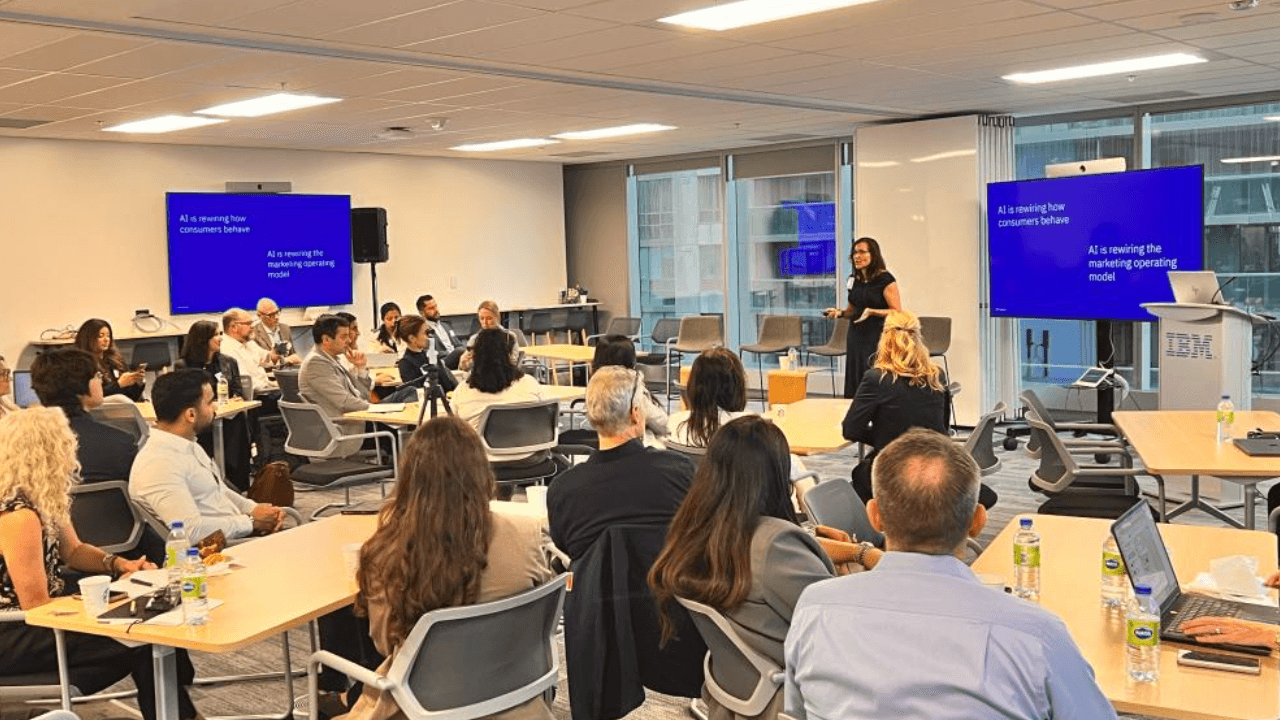
Pictured: IBM's Alexis Zamkow
Agents Are Rewriting the Rules for Customers and CMOs Alike
Alexis Zamkow, Global Intelligent Marketing Lead, IBM
Alexis opened the summit with a jolt: AI agents are no longer a future trend - they are already rewriting how consumers discover, evaluate, and choose financial products. With over 50% of online traffic now generated by bots, she warned that marketers must optimise not just for humans, but for machines.
She showed how generative AI search is disintermediating websites, how agents personalise recommendations using private user histories, and why earned media is becoming more influential than brand-owned content. Her message was clear: the operating model of financial marketing is not ready for AI - but that gap is the biggest opportunity of the decade.
Key Takeaways
AI agents are becoming the primary interface between consumers and brands.
Earned media and third‑party validation now outweigh owned content.
Schema, freshness, and answer‑first writing determine visibility in AI search and GEO (Generative Engine Optimisation) will become as fundamental as SEO.
Marketing must work cross‑functionally with PR, product, and customer service.

Pictured: Sonance Wealth's Thom Antonio
Designing Difference – Launching a New FS Brand in Canada
Thom Antonio, Chief Creative Officer, Sonance Wealth
Thom delivered one of the most energising sessions of the day - a behind‑the‑scenes look at building a new Canadian wealth brand from scratch. He began by showing a wall of competitor websites with the logos swapped: nobody noticed, because the imagery was identical - silver‑haired couples, sailboats, mountain tops, grandchildren. The “sea of sameness” was undeniable.
He walked the room through Sonance’s brand creation journey: interviewing advisors and clients, discovering that both groups wanted “freedom” but defined it differently, and building a brand around harmony, orchestration, and balance. The result: Sonance – ‘soothing finance’ for independently connected advisors, and wealth well‑orchestrated for clients.
Thom’s philosophy was simple: make deliberate choices, elicit visceral reactions, and get comfortable with uncomfortable.
Key Takeaways
Financial services imagery is trapped in a sea of sameness - break it deliberately.
Great brands emerge from deep listening, not internal assumptions.
Show it, don’t say it - video and visual identity matter more than ever.
A brand should fit on one page: clarity beats complexity.
Leading Integrated Growth
Fate Saghir, CPA (Mackenzie Investments), Meaghan Kelly (AGF Investments), Nisha Carcasole (Mastercard)
The first panel of the day was unusually deep - a genuine leadership conversation about how growth is built inside modern financial institutions.
AGF Investments’ Meaghan Kelly described how integrating product and marketing has transformed her organisation: marketers now report on business metrics, not marketing metrics, and share accountability with distribution. Mackenzie Investments’ Fate Saghir reframed integrated growth as designing around client outcomes - not structures - and showed how sustainability, CX, and marketing can operate as a single growth engine. Mastercard’s Nisha Carcasole emphasised connection: breaking silos, aligning briefs, and ensuring every part of the organisation shows up as “one Mastercard.”
The conversation turned to AI, where all three leaders shared a common tension: AI accelerates productivity, but also risks brand erosion. Guardrails, curiosity, and workflow redesign were recurring themes.
Key Takeaways
Integrated growth requires shared KPIs across product, marketing, and distribution, and client outcomes - not org charts - should determine how teams collaborate.
AI boosts productivity but demands strict brand governance.
Curiosity and breaking legacy processes are essential for next‑year planning.
Connection beats coordination: ecosystems outperform silos.

Pictured from left to right: Globe & Mail's Sean Stanleigh, Raymond James' Sai Man and independent consultant, Ayesha Khan
Advisor Engagement & AI‑Driven Service Models
Sai Man (Raymond James) and Ayesha Khan MBA, moderated by Sean Stanleigh (The Globe and Mail)
This panel explored how technology is reshaping advisor productivity and investor expectations. Raymond James’ Sai Man explained that advisors typically spend only ~12% of their time actually speaking to clients - and that AI can liberate them from administrative burden. He also highlighted a surprising truth: when recruiting advisors, culture matters more than technology.
Ayesha Khan spoke about big data, trust, and the risks of feeding proprietary information into external AI platforms. She emphasised that younger investors crave autonomy and transparency - but also desperately need education. DIY investing is rising, but financial literacy is not.
The conversation turned to generational change: wealth transfer, digital expectations, and the need for advisors to build relationships long before assets move.
Key Takeaways
AI frees advisors to spend more time on high‑value client relationships.
Younger investors want autonomy, but also guidance and education.
Trust is a human currency; AI cannot manufacture it.
Brands must earn “share of mind” in an AI‑driven discovery landscape.

Pictured: Final Upgrade AI's Dominique Rose Van-Winther
Workplace Transformation – How Marketing Teams Are Changing
Dominique Rose Van-Winther, CEO, Final Upgrade AI
Dominique delivered an electric session that reframed AI entirely: the bottleneck isn’t technology, it’s behaviour. Most marketers use AI for just 17% of their work; with training, that jumps to 55%. But the real breakthrough comes when teams redesign workflows and build AI agents - unlocking 18–25 hours a week and transforming how work gets done.
She showed how global organisations are eliminating rework, replacing meetings with “jam sessions,” and letting AI generate full outputs from recorded conversations. Her warning was clear: without a bold North Star, teams simply fill their saved time with “comfort work.” The opportunity is to become 10X humans - spending less time typing and more time thinking, collaborating, and creating value.
Key Takeaways
AI transformation is behavioural, not technical.
Every marketer should learn to build AI agents.
A clear North Star prevents wasted “comfort work.”
The future belongs to 10X humans.

Pictured from left to right: University of Waterloo's Shabnam Ivkovic, Espresso Capital's Aparna Allam and CIBC Mellon's Brent Merriman
Culture, Talent & the AI Generation
Aparna Allam (Espresso Capital), Brent Merriman (CIBC Mellon), moderated by Shabnam (Shay) Ivković, PEng (ON) (University of Waterloo)
This session tackled one of the industry’s most urgent issues: how to build culture and develop talent in an AI‑accelerated world. Espresso Capital's Aparna Allam described how she engineered a cross‑trained, trust‑based marketing team using RASCI mapping and role overlap. CIBC Mellon's Brent Merriman shared a remarkable statistic: in 15 years, he has had only 1.5 voluntary resignations - a testament to building a “talent engine,” not just a team.
Both speakers warned of a looming challenge: Gen Z will get “good” for free through AI, but may not learn the craft required to become great. The industry must rethink how it trains, stretches, and mentors emerging talent.
Key Takeaways
Culture must be engineered - cohesion and trust don’t happen by accident.
Cross‑training prevents silos and builds resilience.
AI flattens early‑career skill development - stretch assignments are essential.
Hiring signals are changing: resumes are less reliable, networks matter more.
The next generation needs both autonomy and human guidance.

Pictured: AL Media's Alex Leonard
New Content: Making the Far Away Feel Real
Alex Leonard, MES, CM, Filmmaker & Content Strategist
Alex brought energy and practicality to the content conversation. His thesis: people care when content feels real, human, and close - even when the subject is far away. He illustrated this through his award‑winning elephant conservation documentary, showing how storytelling can make distant issues emotionally resonant.
He challenged marketers to “give it a go” - to get comfortable on camera, embrace messy first takes, find their unique voice, and build confidence through repetition. Video, he argued, is the most powerful tool marketers have to cut through sameness and rebuild trust in an AI‑saturated world.
Key Takeaways
Video is the fastest path to emotional connection.
Confidence comes from habit and repetition.
Messy first takes are essential - perfection kills creativity.
Content should provoke care, not just convey information.

Pictured from left to right: FMI's Jacob Howard interviewing PWL Capital's Angelica Montagano
Disturbing Convention: The PWL Capital Story
Angelica Montagano, Head of Brand Experience, PWL Capital Inc
Angelica closed the day with a candid, high‑energy keynote on building one of Canada’s most successful content engines. PWL’s Rational Reminder podcast (11M downloads), YouTube channel (650k subscribers), and 1,500‑plus blogs have made the firm a national authority.
Her philosophy is simple: disturb convention. Not disrupt - disturb. Do things that feel weird, uncomfortable, or “cringe,” because that’s where differentiation lives. She shared how PWL joined Reddit communities, rebuilt its website (leading to a 209% increase in leads), and developed personas based on psychology, not demographics.
Angelica urged marketers to embrace creativity in a regulated industry, be proud “marketing nerds,” and remember that AI cannot replace human connection.
Key Takeaways
Disturbing convention creates differentiation.
Persona‑based marketing beats demographic segmentation.
Reddit and online communities can be powerful brand accelerators.
Creativity matters more in regulated industries, not less.
Final Thoughts
The Canadian Financial Services Marketing Leaders’ Summit 2026 was a day defined by intelligence, candour, and ambition. Across AI, brand, content, advisor engagement, and culture, one theme stood out: human connection is more important than ever.
Thank you to all speakers, attendees, and partners - and to IBM for hosting. Until next time, keep building, keep experimenting, and keep marketing with purpose.