Events
From Friction to Flow: Highlights of the Asset Management Marketing Leaders' RoundTable
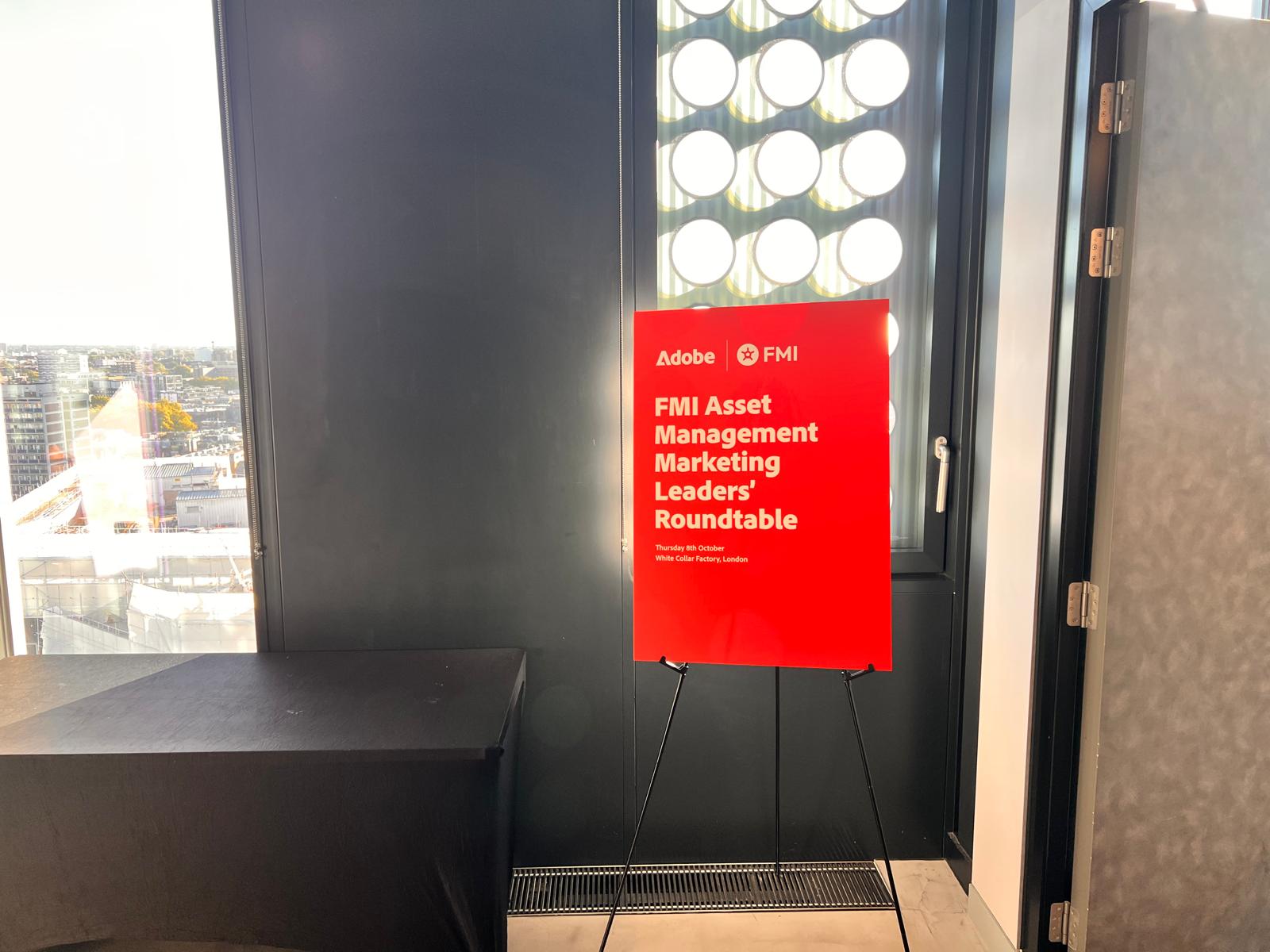
On 8th October 2026, Financial Marketing Insights ran its first dedicated Asset Management Marketing Leaders’ Roundtable at Adobe’s London headquarters in sunny Shoreditch.
Leaders from seven of the leading asset management firms in the UK joined us, and Simon Murray, Practice Lead for Regulated Industries at Adobe set the scene - that asset management is shifting under the weight of fee pressure, regulatory load and changing discovery behaviours, and the room was ready for a conversation that went beyond tools and into operating models.
Dominique Rose Van‑Winther: Marketing teams are changing
Dominique Rose Van‑Winther, CEO of Final Upgrade AI, gave an energizing opening key note. She began by providing industry benchmarks on AI maturity in financial services marketing, noting that while the average professional spends around 17% of their time using AI, those who are properly empowered can reach 55% - a shift that unlocks the equivalent time of a “Tuesday and Wednesday, or a long weekend” as she put it. But the percentage wasn’t the headline. What Dominique wanted the room to focus on was the shift in working habits and ambition that sits underneath it - the foundation for creating 10x humans with a clear North Star. As she put it, “This journey has nothing to do about technology… it has everything to do with changing people’s behavior.”
Her most striking illustration was the typical marketing campaign workflow. Pre‑AI, it might take roughly fifteen days and twenty‑four hours of human labour. Even with basic AI adoption, elapsed time barely shifts because the bottleneck is the handoff and approvals between teams. But when you redesign the workflow - mapping every dependency, every stakeholder voice - the entire process collapses to a couple of hours of human review. As she put it, “Imagine we ask each of these people, what do you do at each stage? Tell me everything… it will go and do all of that process and go, ‘here’s your packet for final review.’”
Dominique’s message landed: AI doesn’t fix broken processes; it can amplify them. Fix the process first, then automate.
Boundaries are Blurring
Adobe’s Simon Murray then presented a short but resonant perspective on the evolving relationship between sales and marketing. Historically, these teams have operated in parallel - marketing generating content and campaigns, sales working directly with clients, and each relying on different systems, data sources and rhythms.
But as Simon pointed out, that separation is dissolving. When both teams have access to the same dashboards, the same signals, the same buying‑group intelligence and the same AI‑enabled agents, the traditional handoff between marketing and sales becomes less relevant. The boundary blurs. The work converges.
Simon highlighted a familiar challenge: the gap between what marketing creates, what sales needs, and what compliance can approve in time - a gap that increasingly determines how fast firms can respond to clients and markets. Close that gap, and growth follows. In a world where buying groups behave dynamically and discovery increasingly happens through AI, the firms that succeed will be those where sales and marketing operate as a single, orchestrated system rather than two adjacent functions.
His framing helped illuminate the broader discussion that followed, as the group explored four frictions where better alignment - across teams, data, processes and platforms - is becoming increasingly important.
Friction 1: Siloed data and the missing investor view
The first friction centred on data. Everyone in the room recognised the problem: investor information scattered across various CRM systems, digital platforms, account databases and content repositories, with no unified profile to anchor buying‑group understanding. Simon explained that when data is scattered across different systems, it becomes almost impossible to see who is actually involved in a buying decision or how their preferences connect across products. The marketing leaders in the room recognised the problem immediately.
One leader suggested that IT is often not the right owner to lead AI marketing automation. Dominique reinforced this with her observation that Excel has thousands of functions, PowerPoint has hundreds, but Copilot has only a few — prompting the question of why marketing should be dependent on IT for workflow redesign. That led to the idea of a new role: the marketing data engineer, someone who understands marketing deeply but can also manage taxonomies, governance, data quality and compliance. Without that discipline, firms risk ending up with data swamps rather than data lakes.
Friction 2: Compliance and content at the speed of markets
The second friction was compliance and content velocity. One asset manager shared that they now have two “marketing assurance” specialists trained by compliance and embedded within marketing, giving the team devolved authority to approve content at speed. Dominique’s workflow redesign example resonated strongly here. Her approach - hosting “rant sessions” to surface the real workflow - often reveals that compliance is blamed for delays simply because it sits at the end of a broken process. In a better‑designed workflow, compliance isn’t a final hurdle; it’s built in from the start.
Simon noted that turning a market‑moving event into sign‑off‑ready commentary might often takes weeks, by which point the moment has passed. With the right AI‑enabled content supply chain, those bottlenecks can be reduced from weeks to hours. The real challenge is not compliance or regulation but the choreography of people, steps and expectations.
Friction 3: Buying groups, not funnels
The third friction focused on buying journeys and buying groups. Simon described this as ABM 3.0 - a shift from rules‑based lead scoring to predictive identification of buying groups. The traditional funnel is giving way to a flywheel model where firms can, with the right data foundation, market to a segment of one.
Most asset managers currently track only a fraction of buying‑group engagement, which means outreach is often mistimed against how CIOs, portfolio managers, risk teams and consultants actually research and decide. The institutional marketers in the room recognised the challenge immediately; mapping buying groups is difficult, but AI finally gives firms the potential ability to orchestrate journeys at the level of individual stakeholders.
Friction 4: Discoverability in the age of AI
The fourth friction - discoverability - was perhaps the most resonant. One attendee noted that human traffic to asset manager websites is declining, but bot traffic is exploding. LLMs and agents are scraping websites constantly to answer user prompts, which means a firm’s website is no longer just a client touchpoint; it is its machine‑readable ‘global information repository’.
Simon explained that website content or fund information buried in JavaScript and PDFs, are too hard to parse and simply get missed by LLMs. The analogy he shared from his time in investment banking was telling: it turned out that clients didn’t want dedicated customer portals; they wanted back-end data feeds. The same shift is coming to asset management. Clients won’t want to browse each asset manager’s fund centres; they’ll want clean, structured, machine‑readable data delivered directly into their systems. In this new world, discoverability becomes a question of trust. Both humans and LLMs respond to consistent, well‑structured messaging, and firms that present a stable, coherent narrative are the ones most likely to succeed.
Human connection: events, relationships and trust
Amid all the talk of AI, data and processes, a quieter theme emerged: the renewed importance of human connection. Several attendees noted that in a world saturated with AI‑generated content, events are becoming more valuable, not less. People want to meet, to compare experiences, to build relationships and to understand how others are navigating the same pressures. The roundtable itself was evidence of that - a room full of senior marketers sharing marketing challenges, acknowledging that AI integration is difficult, and recognising that the hardest part of transformation is not the technology but the organisational change that surrounds it.
A sector on the move
By the end of the morning, what stood out most was not a single framework or tool, but the sense of movement across the industry. Asset management marketers are navigating a moment where new capabilities are arriving faster than operating models can absorb them, and yet the mood in the room was unmistakably optimistic. Silos are beginning to come down. Data foundations are strengthening. Compliance is becoming a partner rather than a brake. Buying‑group intelligence is maturing. Discoverability is being rethought from the ground up. And through all of it, the human relationships that define this industry remain central.
All in all, it was a fantastic event - the first of many more focused roundtables for asset management marketers. Many thanks to all who attended and to Adobe for hosting!