CMO Digest
FinTech 2026: The Great Convergence - Why Every FS Marketer Now Plays in the Same Arena

For years, financial services has been framed as a story of two worlds: fintechs as the bold disruptors, incumbents as the cautious giants, and marketers navigating the tension between them. In this CMO Digest we look at the latest research - from Forbes’ Fintech 50, KPMG’s Pulse of Fintech, and Finastra’s State of the Nation 2026 - that shows that this narrative no longer reflects reality. The sector is not diverging. It is converging.
Fintechs are maturing into institutional‑grade partners. Incumbents are modernising with fintech‑like speed. And across the board, organisations are being judged on the same criteria: intelligence, interoperability, trust, and the ability to deliver meaningful outcomes. The old categories simply don’t describe the market anymore.
FinTech Grows Up: From Disruption to Infrastructure
The companies featured in Forbes’ 2026 Fintech 50 are not chasing mass‑market consumers or subsidised growth. They are building the plumbing of the industry - automated insurance inspections, cross‑border B2B payments, compliance automation, treasury infrastructure. This shift is reflected in the composition of the list itself, with 20 newcomers demonstrating that innovation is now concentrated in deep, operational problem‑solving rather than consumer hype.
Fintech is no longer the outsider. It is becoming part of the machinery that keeps financial services running.
Incumbents Modernise: The End of “Legacy” as a Label
KPMG’s analysis shows global fintech investment rebounding to $116 billion, even as deal volume hits an eight‑year low (see KPMG chart below). Fewer deals, bigger cheques, and a flight to quality. The platforms attracting capital look remarkably like the fintechs they once competed with: cloud‑native, API‑driven, AI‑enabled, and modular.
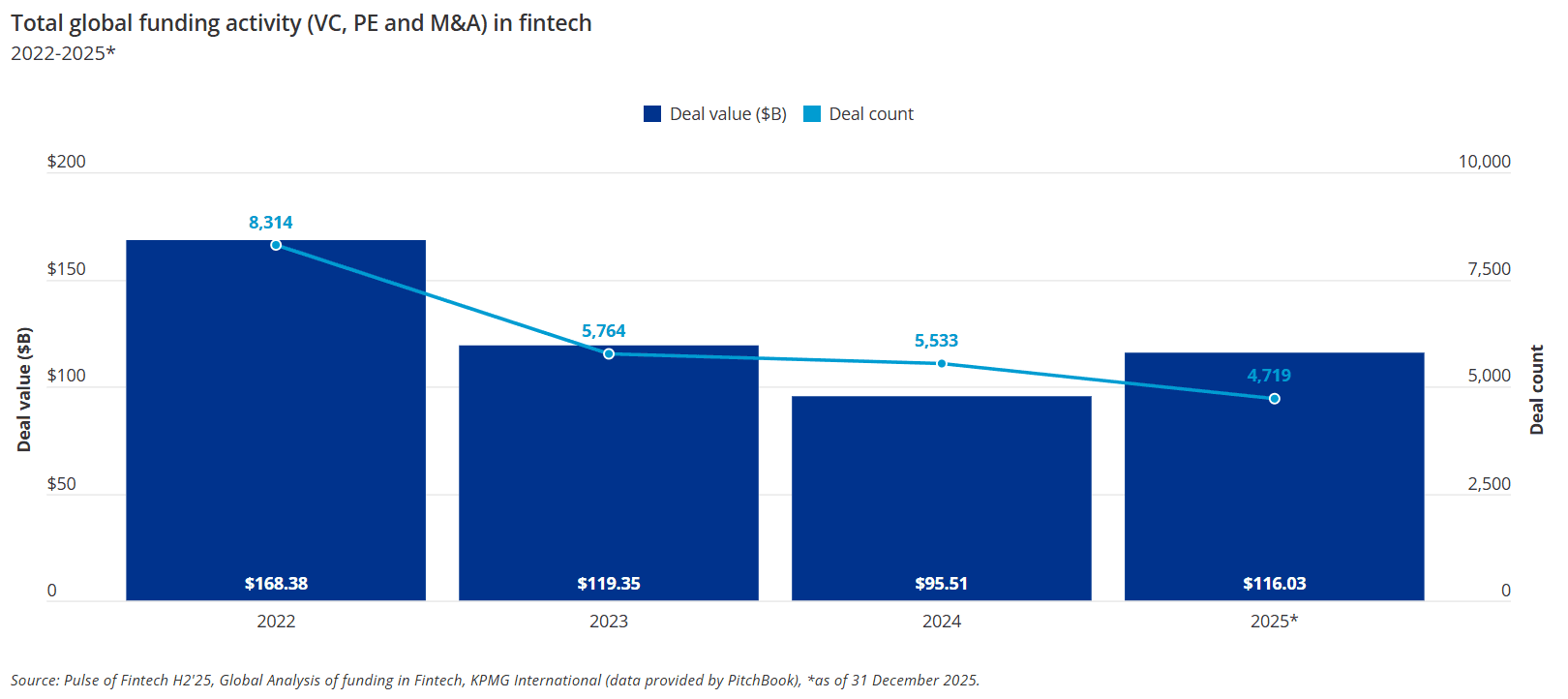
Traditional FS firms are not simply adopting new tools; they are re‑architecting their operating models around them. The result is a sector where incumbents behave more like fintechs - and fintechs increasingly resemble the institutional partners they once sought to disrupt.
AI Crosses the Threshold - and Customer Expectations Follow
Finastra’s 2026 research captures the moment with striking clarity: only 2% of financial institutions now report no AI use (see Finastra's chart below). The industry has crossed a threshold. AI is no longer an experiment; it is infrastructure.
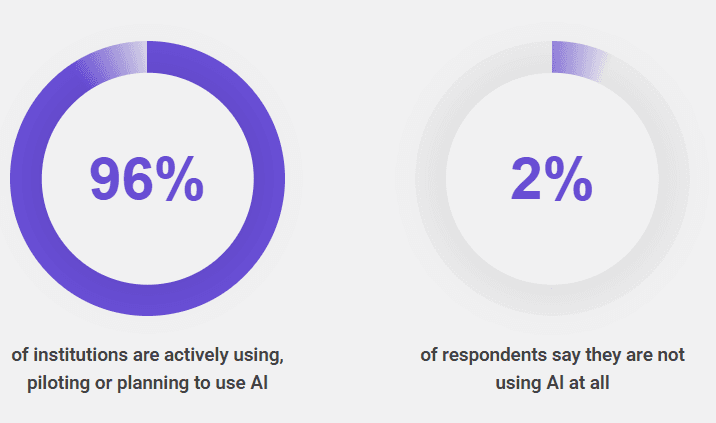
As AI becomes embedded across the value chain, customer expectations are rising just as quickly.
Finastra’s data shows that 38% of institutions now identify personalised service as the top customer demand - but customers also want reassurance. The future is not purely digital; it is hybrid. People expect the speed and precision of AI, paired with the empathy and judgment of human experts. The seamless hand‑off between the two is becoming a defining feature of modern financial services.
This shift is also reshaping the role of trust. As institutions deepen their reliance on AI, security and resilience move from back‑office concerns to front‑of‑house brand pillars. Customers want to know not only that their experiences are personalised, but that their data is protected and their interactions are safe. Trust is no longer implied; it must be demonstrated.
At the same time, the rise of ecosystem partnerships is accelerating. Finastra reports that 54% of institutions now use fintech collaborations as their default modernisation strategy. No organisation can credibly claim to innovate alone. The winners will be those who position themselves as agile, collaborative hubs - orchestrating the best capabilities from across the ecosystem and presenting them to customers as a seamless whole.
Key Insights for FS CMOs:
Hyper-Segmentation: Success now lies in dominating narrow niches (e.g., specific immigrant corridors or specialized industries) rather than the general public. Innovation is expanding into historically "un-disrupted" areas like private credit, debt, and export finance. For CMOs, this represents an opportunity to lead narratives on the modernization of institutional back-office and middle-office operations.
The AI "Differentiation" Mandate: As AI investment surges, CMOs must move beyond the "AI-powered" label. Marketing must now demonstrate unique intellectual property or "Agentic AI" that delivers tangible business model transformation rather than simple automation.
Regional Strategy Realignment: While the US dominates funding, the APAC region is leading the charge in asset management transformation (cloud and AI agents), while the UAE is emerging as a global hub for tokenization. Marketing strategies should reflect these specific regional leadership roles.
Consolidation-Driven Messaging: As smaller providers consolidate to gain scale, CMOs at larger institutions should highlight "stability" and "interoperability," marketing their firms as the secure anchor in an increasingly interconnected fintech ecosystem.
The Big Picture: A Single, Intelligent, Interconnected Ecosystem
Taken together, these insights point to a single conclusion: the financial services landscape is converging. Fintechs are becoming more institutional. Incumbents are becoming more modular. Everyone is adopting AI. Everyone is integrating with everyone else. And everyone is being asked to prove not just what they do, but how they fit into a larger, interconnected system.
This convergence demands a new kind of marketing - one that blends trust with innovation, precision with narrative, and ecosystem value with clear differentiation.
The winners in this new era will not be the loudest disruptors or the most established institutions. They will be the organisations that understand their role in the ecosystem, communicate it with authority, and deliver on it with intelligence and interoperability.
Links:
· https://www.finastra.com/financial-services-state-nation-survey-2026
· https://www.forbes.com/sites/jeffkauflin/2026/02/19/the-50-hottest-fintech-startups-in-2026/
· https://kpmg.com/cn/en/insights/2026/03/pulse-of-fintech-h2-25.html